How it works

Five-day turnaround. Usually faster.

In every county we source, the records are already OCR'd, normalized, and pre-vetted. When you give us a tract, we're not starting from scratch - we're filtering our standing index, running the chain, writing the abstractor's notes, and delivering. Standard turnaround is five business days; most jobs ship sooner.

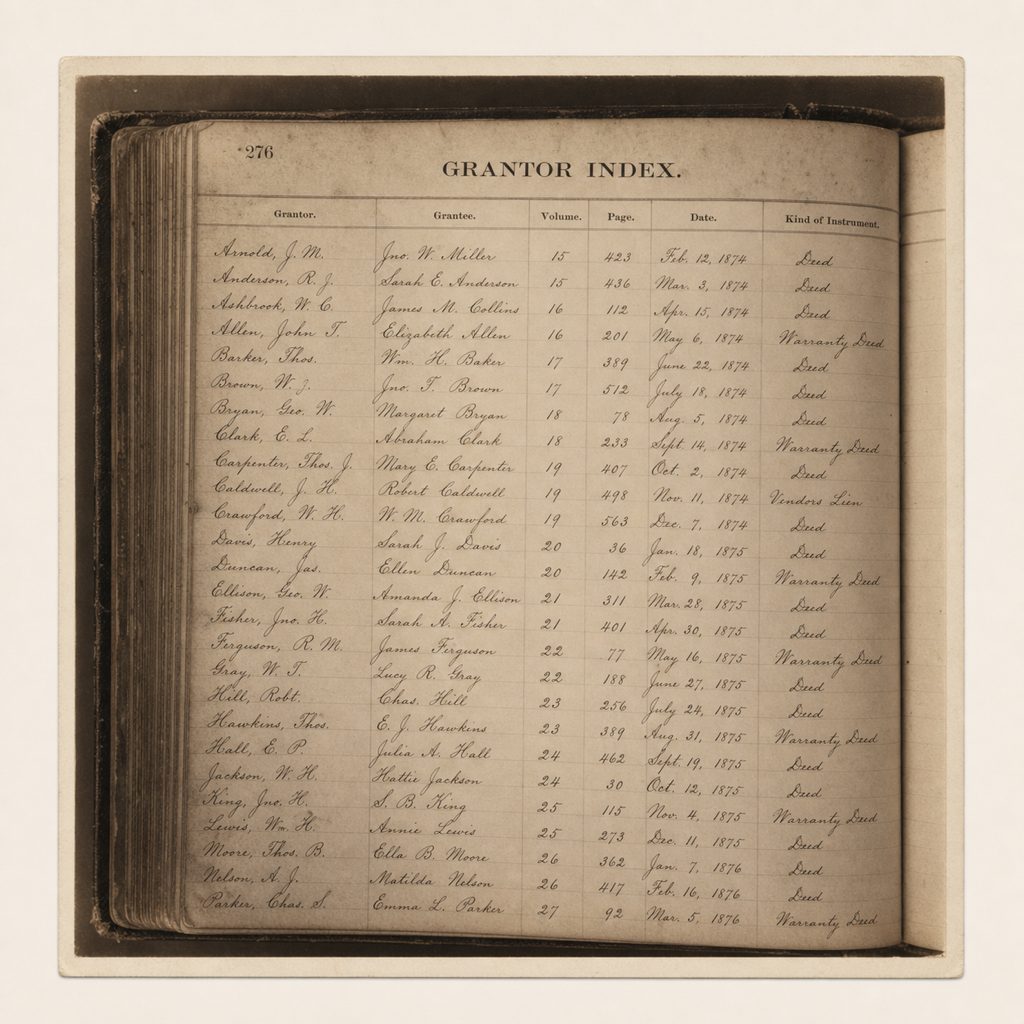
1870s Texas county clerk grantor index ledger, sepia photograph

The service, in three layers

What you're hiring when you hire County.Land.

Title research is slow because the work is fragmented across three different layers - records, expertise, and fieldwork - and most teams have to assemble that themselves on every job. We run all three under one roof.

Layer 1

The county data layer.

For every county we source, the clerk's index is already OCR'd, the parties and legals are normalized, the chain is pre-walked, and the document set is pre-vetted by a AAPL-member senior landman (often RPL or CPL). That work happens once, up front. By the time you call us, the heavy lifting on the county is finished.

Today the layer carries hundreds of thousands of recorded instruments per county across the Texas counties we source - deeds, oil & gas leases, mineral conveyances, releases, affidavits of heirship, probate filings, easements, and ROWs - with wells, permits, parcels, and ownership stitched alongside.

Layer 2

In-house abstractors.

Texas landmen on staff, AAPL members, many holding RPL or CPL credentials. They take your tract, filter the standing index to it, construct the chain, write the abstractor's notes, and stitch wells, leases, and ownership. Every workbook is reviewed and signed off by a senior landman before it ships.

This is where the judgment lives. The data layer makes it fast; the abstractor makes it correct.

Layer 3

Field network.

Some records still only live at the courthouse - older deed volumes, hand-indexed mineral books, probate files, plat books, oil & gas lease books in unconsolidated counties. When the job needs them, we dispatch from our network of independent AAPL-member Texas landmen who work each county.

They pull the volumes, capture them at archival resolution, and the searchable PDFs land in your secure folder the same day, with a vol/page manifest.
What happens in five days

From your email to your workbook.

Day 0

You name the tract.

County, parcel ID or legal description, and what you're trying to answer. A short scoping email is enough.

Days 1-2

Abstractor pass.

An in-house landman filters the pre-vetted county index to your tract, constructs the chain, adds Abstractor's Notes, and pulls supporting wells, permits, and skip-traced ownership.

Days 3-4

QA & senior review.

A senior landman reviews flagged rows, signs off on the abstractor's summary, and verifies the Document Library nomenclature. If anything in the chain needs a courthouse pull, the field network is dispatched in parallel.

Day 5

Delivered.

Linked workbook + Document Library + written abstractor's summary. You can be in your buyer's office on Monday with Friday's tract title work. See the interactive sample or the full County Foundation spec.

When five days isn't the right SLA

Custom jobs and specialty language.

Some engagements require specialty language work, litigation-grade chain construction, expert-witness research, curative work that needs filings or document drafting, M&A diligence under tight NDA. Those are scoped and quoted separately, or you can narrow the scope to a single survey with an abstract runsheet. See Custom Abstracting for the day-rate / retainer engagement model.